
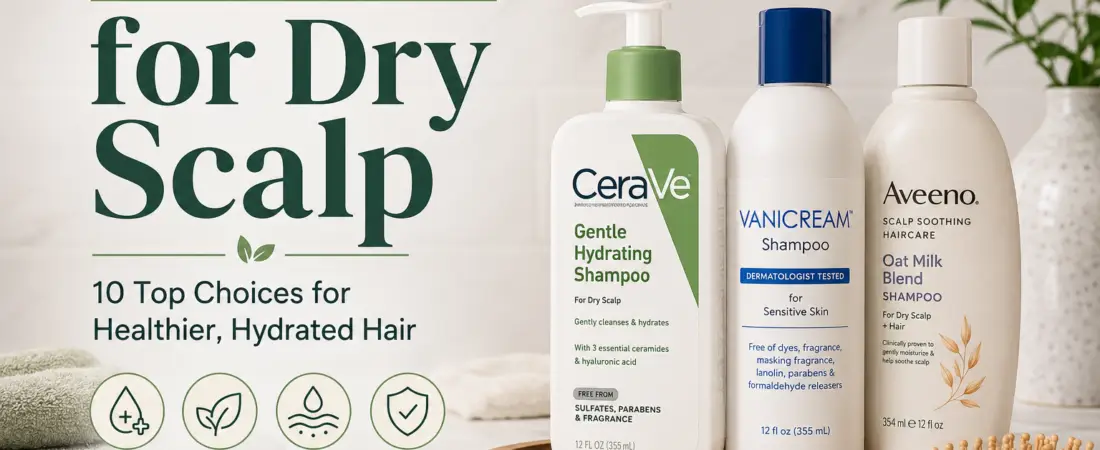
A dry scalp can be surprisingly uncomfortable. It may feel tight, itchy, irritated, or unusually flaky, especially after washing your hair. And when your scalp is dry, choosing the right shampoo can make a noticeable difference.
The best shampoo for dry scalp is not necessarily the one that produces the most foam or leaves your hair feeling extremely clean. In many cases, a gentle formula that cleans the scalp without unnecessarily removing its natural oils is a better choice.
Dry scalp can have several causes, including cold or dry weather, frequent washing, hot showers, irritating hair products, and certain skin conditions. That is why there is no single shampoo that works perfectly for everyone.
In this guide, we’ll look at 10 popular shampoo choices for dry scalp, the ingredients worth looking for, ingredients you may want to avoid, the difference between dry scalp and dandruff, and practical tips for washing and caring for a dry scalp.e
Introduction:
Quick answer: If your main problem is simple dryness rather than dandruff, start with a gentle, moisturizing, fragrance-free shampoo. If you have persistent flakes, redness, or significant itching, you may need a dandruff shampoo or advice from a dermatologist.
What Causes a Dry Scalp?
Your scalp needs a healthy balance of water and natural oils to remain comfortable. When that balance is disrupted, the skin can lose moisture and become dry, tight, itchy, or flaky.
One of the most common causes is dry weather. Cold temperatures and low humidity can reduce moisture in the skin, including the scalp. Indoor heating can make the air even drier.
Your hair-washing routine can also contribute. Washing too frequently, using very hot water, or choosing a shampoo that is too harsh for your scalp may remove more oil than your scalp needs.
Other potential causes include:
– Very hot showers
– Frequent shampooing
– Harsh cleansing products
– Fragrances or other irritating ingredients
– Excessive use of styling products
– Chemical hair treatments
– Cold or low-humidity weather
– Certain skin conditions
– Dehydrated or sensitive skin
It is also important to remember that dry scalp and dandruff are not exactly the same thing. They can look similar, but the underlying causes and treatments can be different. The American Academy of Dermatology notes that dry scalp can improve after switching to a gentle, non-medicated shampoo, while dandruff may require a shampoo containing an appropriate anti-dandruff active ingredient.
Best Shampoos for Dry Scalp
Finding the best shampoo for dry scalp depends on why your scalp is dry, how sensitive it is, and what your hair type needs.
Here are 10 products worth considering. Rather than ranking them purely from “best” to “worst,” we’ve grouped them according to the type of scalp or hair concern they may suit.
1. CeraVe Gentle Hydrating Shampoo — Best Overall for Dry Scalp
If your priority is gentle cleansing and hydration, CeraVe Gentle Hydrating Shampoo is a strong option to consider.
Its formula contains ceramides, hyaluronic acid, and niacinamide. CeraVe says the shampoo is designed to cleanse without stripping away moisture and is fragrance-free, sulfate-free, paraben-free, and suitable for sensitive scalps.
Best for: Dry or sensitive scalp and people who want a gentle everyday shampoo.
Why consider it: The formula focuses on cleansing while supporting the scalp’s moisture barrier.
2. Vanicream Shampoo — Best for Sensitive Scalp
For people who are particularly sensitive to fragrances and unnecessary additives, Vanicream Shampoo is another option worth looking at.
The manufacturer describes it as a non-medicated shampoo formulated for sensitive skin. It is fragrance-free, sulfate-free, gluten-free, and free from botanical extracts and essential oils.
Best for: Sensitive, easily irritated scalps.
Why consider it: Its relatively simple formulation can make it a useful choice when you want to minimize potential irritants.
3. CeraVe Anti-Dandruff Hydrating Shampoo — Best for Dry Scalp With Dandruff
Sometimes what appears to be a dry scalp is actually dandruff. In that situation, a basic moisturizing shampoo may not be enough.
CeraVe Anti-Dandruff Hydrating Shampoo combines an anti-dandruff active ingredient with ingredients such as ceramides, hyaluronic acid, and niacinamide. CeraVe lists 1% pyrithione zinc as the active ingredient in its formula.
Best for: People dealing with flakes, itching, and irritation associated with dandruff.
Why consider it: It is designed to address dandruff while also providing a more hydrating cleansing experience.
4. Vanicream Anti Dandruff Shampoo — Best for Dandruff-Prone Sensitive Scalps
If your scalp is both sensitive and prone to dandruff, a medicated option may be more appropriate than a standard moisturizing shampoo.
Vanicream’s Dandruff Shampoo is an over-the-counter dandruff shampoo containing zinc pyrithione and is designed to control symptoms associated with dandruff and seborrheic dermatitis.
Best for: Dandruff-prone scalps that are also sensitive.
Why consider it: It combines dandruff treatment with the brand’s focus on sensitive-skin formulations.
5. Neutrogena Hydro Boost Shampoo — Best for Lightweight Hydration
A lightweight moisturizing shampoo can be useful if you want hydration without making your hair feel heavily coated.
Look for formulas designed around humectants and moisturizing ingredients, particularly if your hair feels dry immediately after washing.
Best for: People who want lightweight moisture and a clean, fresh hair feel.
Why consider it: A lighter hydrating formula may work particularly well for people whose hair becomes weighed down easily.
Always check the current ingredient list and product availability before publishing an affiliate recommendation.
6. Aveeno Oat Milk Blend Shampoo — Best for Gentle Hair Care
Oat-based hair-care formulas are popular among people who want a gentler cleansing routine.
An oat-containing shampoo may be particularly appealing if your hair feels dry or rough after washing and you want a product focused on softness as well as cleansing.
Best for: Dry hair combined with a mildly dry scalp.
Why consider it: Oat-based formulations can provide a softer, more conditioning hair-care experience.
7. Bioderma Nodé Fluide Shampoo — Best for Frequent Washing
Some people need to wash their hair frequently because of their lifestyle, hair type, or scalp oil production. In that situation, an extremely aggressive cleansing routine can leave the scalp feeling uncomfortable.
A gentle daily-use shampoo can be a better approach.
Best for: People who need frequent cleansing but want to avoid an overly harsh washing routine.
Why consider it: A gentle cleanser can help you maintain scalp hygiene without treating every wash like a deep-cleaning session.
8. Eucerin DermoCapillaire Calming Urea Shampoo — Best for Very Dry, Tight Scalp
If your scalp feels particularly dry and tight, look for products specifically formulated for dry or sensitive scalp conditions.
Urea is a well-known moisturizing ingredient used in skincare, and some scalp-care formulas use it to support hydration.
Best for: Very dry or tight-feeling scalps.
Why consider it: It is designed around the needs of dry scalp rather than simply providing cosmetic softness to the hair.
9. SheaMoisture Manuka Honey & Mafura Oil Shampoo — Best for Dry, Textured Hair
People with curly, coily, or highly textured hair often have different moisture needs from people with fine, straight hair.
A richer moisturizing shampoo may be preferable when the hair itself becomes extremely dry and prone to breakage.
Best for: Dry, curly, coily, or textured hair.
Why consider it: Richer formulas can help make cleansing less drying for hair that naturally struggles to retain moisture.
However, if your scalp is sensitive, check the ingredient list carefully because botanical ingredients and fragrance can bother some people.
10. Head & Shoulders Clinical or Anti-Dandruff Shampoo — Best for Flaking Caused by Dandruff
If your “dry scalp” actually involves persistent dandruff, an anti-dandruff shampoo may be more appropriate than a standard moisturizing shampoo.
The American Academy of Dermatology lists several active ingredients used in dandruff shampoos, including selenium sulfide, salicylic acid, ketoconazole, sulfur, and zinc pyrithione.
Best for: Persistent flakes and dandruff rather than simple dry skin.
Why consider it: Treating the underlying dandruff can be more effective than repeatedly adding moisture to a scalp that is actually affected by another condition.
What to Look for in a Shampoo for Dry Scalp
When shopping for the best shampoo for dry scalp, don’t focus only on marketing claims such as “moisturizing” or “natural.” Look at the formulation.
1. Gentle cleansing agents A shampoo needs to remove sweat, oil, dirt, and product buildup, but excessive cleansing can leave some scalps feeling stripped.If your scalp feels tight immediately after washing, your shampoo may be too aggressive for your needs.
2. Humectants Humectants help attract and retain water. Common examples include:GlycerinHyaluronic acidPanthenolUreaThese ingredients are commonly used in moisturizing skin and hair products.
3. Barrier-supporting ingredients Ingredients such as ceramides can be useful in products designed to support the skin barrier.CeraVe, for example, uses ceramides and hyaluronic acid in its hydrating shampoo formulations.
4. Fragrance-free formulas If your scalp is easily irritated, a fragrance-free shampoo may be worth considering.”Fragrance-free” does not automatically mean a product will work for everyone, but eliminating fragrance can reduce one potential source of irritation.
5. Ingredients suited to your actual problem This is particularly important.If your scalp is simply dry, you may benefit from a gentle moisturizing shampoo.If you have dandruff, however, you may need an anti-dandruff active ingredient instead.
Ingredients to Avoid if You Have a Dry Scalp
There is no universal list of ingredients that every person with a dry scalp must avoid. An ingredient that bothers one person may be completely fine for another. However, if your scalp is dry or sensitive, you may want to be cautious with products containing:
Strong cleansing formulas Some highly cleansing shampoos can leave dry or sensitive scalps feeling stripped, particularly when used frequently.
Fragrance Fragrance is not automatically bad, but it can be irritating for some sensitive scalps. If you repeatedly experience itching or irritation after using fragranced products, try switching to a fragrance-free formula.
Essential oils and botanical extracts” Natural” does not necessarily mean “irritation-free.” Essential oils and plant extracts can cause irritation or allergic reactions in susceptible individuals.
Excessive use of medicated shampoos Anti-dandruff shampoos can be useful when dandruff is the problem, but using a medicated product unnecessarily may not be the best strategy for simple dryness.
The goal is to treat the cause rather than simply use the strongest shampoo available.
Dry Scalp vs. Dandruff: What’s the Difference?
This is one of the most important things to understand before choosing the best shampoo for dry scalp.
Dry scalp generally occurs when the skin loses too much moisture. It can cause small flakes and itching, especially in dry or cold weather.
Dandruff, on the other hand, is associated with increased flaking and can be related to oily skin, hair-care habits, and conditions such as seborrheic dermatitis.
A simple way to think about it:
Dry scalp:
> Often feels tight or dry
> May produce small, dry flakes
> Can become worse in cold or dry weather
> May improve after switching to a gentle shampoo
Dandruff:
> Often produces recurring flakes
> May cause itching
> Can be associated with oily areas of the scalp
> May require an anti-dandruff shampoo
The distinction isn’t always obvious. If you’re unsure, especially if symptoms persist, a dermatologist can help determine what is actually causing the problem.
How to Choose the Best Shampoo for Your Dry Scalp
Instead of buying the first shampoo labeled “hydrating,” consider these five questions.
1. Is your scalp actually dry? If you have heavy or recurring flakes, redness, or significant itching, don’t automatically assume the problem is simple dryness.
2. Is your scalp sensitive? If you frequently experience irritation from hair products, consider a fragrance-free and relatively simple formula.
3. What is your hair type? Fine hair may need lightweight hydration, while curly or coily hair may benefit from richer conditioning formulas.
4. How frequently do you wash? If you wash your hair every day, you may need a particularly gentle shampoo.
5. What happens after washing? This is an underrated test. If your scalp feels comfortable after washing, your shampoo may be a good match.
If it feels extremely tight, itchy, or irritated, consider changing the product or reducing how frequently you wash.
How Often Should You Wash a Dry Scalp?
There isn’t one perfect washing schedule for everyone.Your ideal frequency depends on your hair type, scalp oil production, lifestyle, climate, and the products you use.If your scalp is dry, washing it excessively can sometimes make the problem worse. However, avoiding shampoo altogether isn’t necessarily the solution either.Regular washing with an appropriate shampoo helps remove oil, dead skin cells, sweat, and product buildup.The American Academy of Dermatology recommends adjusting shampoo frequency according to hair type and scalp needs rather than following one universal schedule.
For a dry scalp, a reasonable starting point may be:
Fine or oily hair: More frequent washing may be necessary.
Normal hair: Washing every few days may be sufficient.
Curly, coarse, or textured hair: Less frequent washing may work better.
Very dry or sensitive scalp: Use a gentle shampoo and adjust frequency according to how your scalp responds.
The important thing is to pay attention to your scalp rather than blindly following a fixed schedule.
How to Use Shampoo Properly for a Dry Scalp
Even the best shampoo for dry scalp won’t perform well if you use it incorrectly.
Step 1: Use lukewarm waterAvoid very hot water. Lukewarm water is generally a more comfortable choice for a dry or sensitive scalp.
Step 2: Concentrate shampoo on your scalpYou don’t need to aggressively scrub every inch of your hair.Apply shampoo primarily to the scalp and gently massage with your fingertips.
Step 3: Don’t scratchUsing your fingernails to aggressively scratch flakes away can irritate the scalp and potentially cause small injuries.Use the pads of your fingers instead.
Step 4: Rinse thoroughlyLeftover shampoo can contribute to irritation for some people, so rinse thoroughly.
Step 5: Condition your hairIf your hair is dry, apply conditioner mainly to the lengths and ends, depending on your hair type.
Step 6: Don’t use excessive heatVery hot blow-drying can make already-dry hair feel even drier.Allow your hair to partially air-dry when practical, or use a lower heat setting.
Can Shampoo Get Rid of a Dry Scalp?
A good shampoo can help manage dry scalp, but it may not permanently eliminate the underlying cause.
For example, if your dry scalp is caused by harsh hair products or frequent hot showers, changing your routine may significantly improve the problem.
If the cause is a medical condition, however, shampoo alone may not be enough.
This is why identifying whether you’re dealing with simple dryness, dandruff, seborrheic dermatitis, psoriasis, eczema, or another scalp problem is important.
The American Academy of Dermatology specifically notes that a dry scalp may improve after switching to a gentle, non-medicated shampoo, while persistent conditions may require professional diagnosis and treatment.
So rather than asking, “What shampoo will cure my dry scalp?” a better question is:
“What shampoo is gentle enough for my scalp and appropriate for the reason it’s dry?”
Natural Ways to Help a Dry Scalp
You don’t necessarily need a complicated 10-step hair-care routine to support a dry scalp.
Try these simple habits:
Avoid very hot showersHot water can leave skin feeling dry and uncomfortable.
Reduce unnecessary product buildupHeavy styling products can accumulate on the scalp. Make sure you cleanse your scalp adequately without over-washing.
Use a humidifierIf you live in a dry climate or spend a lot of time in heated indoor environments, adding moisture to the air may help reduce overall skin dryness.
Be gentle with your scalpAvoid aggressive scratching, excessive brushing, and unnecessarily harsh treatments.
Protect your scalp from extreme weatherCold, dry air can contribute to scalp dryness. A hat can help protect your scalp outdoors, provided it is comfortable and kept clean
Don’t assume every natural remedy is safePopular home remedies such as essential oils, lemon juice, vinegar, or undiluted plant extracts can irritate the scalp.
“Natural” is not the same thing as “risk-free.”
When Should You See a Dermatologist?
Most mild cases of dry scalp can be managed with changes to your hair-care routine. But persistent or severe symptoms shouldn’t be ignored.
Consider seeing a dermatologist if you experience:
> Severe or persistent itching
> Redness or inflammation
> Thick scales or plaques
> Bleeding or sores
> Crusting or oozing
> Significant hair loss
> Pain or burning
> Symptoms that keep returning
> No improvement after changing your shampoo and routine
A dermatologist can determine whether the problem is simple dryness or something else.Conditions such as psoriasis, seborrheic dermatitis, eczema, and fungal infections can sometimes resemble ordinary dry scalp. The AAD notes, for example, that scalp ringworm can cause scaling along with hair loss or broken hairs and requires medical treatment.Don’t keep changing shampoos indefinitely if your scalp is getting worse. Sometimes the right solution isn’t another shampoo—it is the correct diagnosis.
Frequently Asked Questions About Dry Scalp
What is the best shampoo for dry scalp?
For simple dryness, look for a gentle, moisturizing shampoo that doesn’t leave your scalp feeling stripped. CeraVe Gentle Hydrating Shampoo and Vanicream Shampoo are examples of formulas designed around gentle cleansing and sensitive-skin needs.
If you have persistent dandruff rather than simple dryness, an anti-dandruff shampoo may be more appropriate.
Should I use anti-dandruff shampoo on a dry scalp?
Not necessarily.
If your scalp is simply dry, a gentle hydrating shampoo may be a better starting point. If you have dandruff, an anti-dandruff shampoo containing an appropriate active ingredient may be more useful.
How often should I shampoo a dry scalp?
There is no universal answer. Wash according to your scalp and hair type. Someone with fine, oily hair may need frequent washing, while someone with dry, curly hair may need considerably less.
Does hot water make dry scalp worse?
Hot water can contribute to skin dryness and irritation. If you have a dry or sensitive scalp, lukewarm water is generally a better choice.
Is sulfate-free shampoo better for dry scalp?
Sulfate-free does not automatically mean better, but some people with dry or sensitive scalps find gentler, sulfate-free formulas more comfortable.
The overall formulation matters more than one ingredient alone.
Can dry scalp cause hair loss?
Simple dryness itself isn’t usually considered a direct cause of significant hair loss. However, severe scratching, inflammation, or an underlying scalp condition can affect hair health.
If you’re experiencing noticeable or sudden hair loss together with scalp symptoms, consult a healthcare professional.
Is dandruff caused by poor hygiene?
No. The American Academy of Dermatology specifically notes that dandruff is not simply the result of poor hygiene. It can have multiple causes, including oily skin, hair-care habits, and certain medical conditions.
Should I oil my dry scalp?
Scalp oiling works well for some people, but it isn’t a universal treatment. Depending on the cause of your symptoms, applying oils may not solve the underlying problem and could be unhelpful if you’re actually dealing with dandruff or another scalp condition.
Can I use dry shampoo if I have a dry scalp?
Dry shampoo should not replace regular shampooing and water. The AAD notes that regular washing with shampoo and water is needed to properly clean the scalp and remove buildup.
If dry shampoo causes itching, burning, or irritation, stop using it.
Final Verdict: Which Shampoo Is Best for Dry Scalp?
The best shampoo for dry scalp depends on what’s actually causing your dryness.
If you’re dealing with straightforward dryness and want a gentle everyday cleanser, a moisturizing, fragrance-free formula such as CeraVe Gentle Hydrating Shampoo is a strong place to start. Its combination of ceramides, hyaluronic acid, and niacinamide is designed around gentle cleansing and scalp hydration.
If you have a particularly sensitive scalp, Vanicream Shampoo is another compelling option because it is fragrance-free and formulated without several common potential irritants.
However, if your scalp is producing persistent flakes and itching, don’t assume you simply need more moisture. You may actually have dandruff. In that case, an appropriate anti-dandruff shampoo may be more useful.
Ultimately, the right shampoo should leave your scalp clean but comfortable—not tight, burning, excessively dry, or irritated.
Start with a gentle formula, pay attention to how your scalp responds, and don’t hesitate to see a dermatologist if symptoms persist.
Bottom line: The best shampoo for dry scalp is the one that matches your scalp’s actual needs—not necessarily the one with the most expensive price tag or the longest list of ingredients.